The Arctic Surface Climate in CMIP6: Status and Developments since CMIP5
A comparison of Arctic surface climate across two generations of global climate models.
Research / Climate Processes & Models
Boundary-layer physics, temperature variability and careful model evaluation connect mechanisms to the climate patterns we observe.
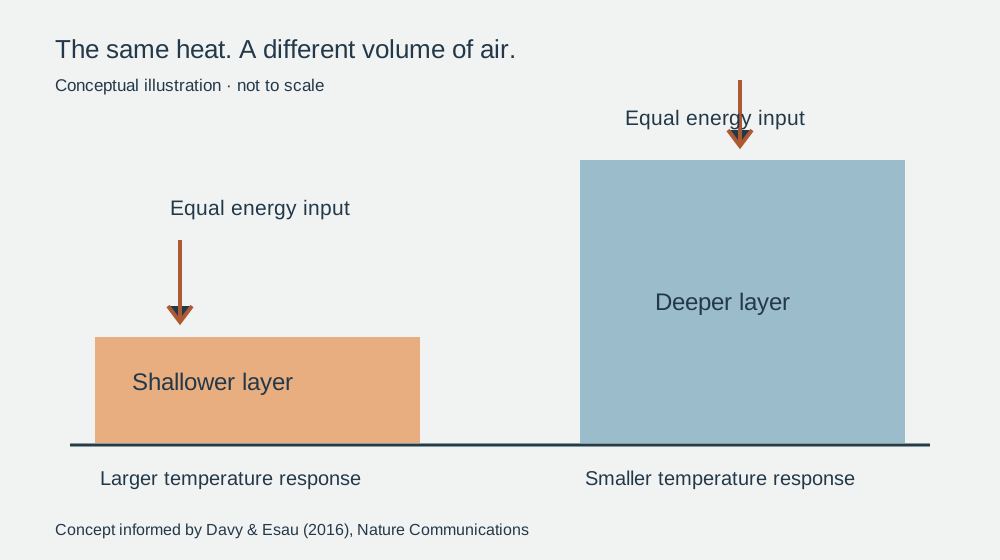
Heat distributed through a shallow layer of air can produce a larger temperature change than the same energy distributed through a deeper layer. With Igor Esau, I examined how this physical perspective helps explain differences in climate-forcing efficacy.
The lower atmosphere changes over the day and with weather conditions. Work with Igor Esau, Alexander Chernokulsky, Stephen Outten and Sergej Zilitinkevich examined how this contributes to asymmetric warming. Related work connects boundary-layer representation with modelled temperature trends and variability.
A model can reproduce one large-scale measure while retaining important regional or seasonal biases. My work on CMIP and Arctic surface climate asks which processes support: or undermine: the interpretation of those outputs.
My doctoral work on the Martian atmosphere and NASA’s Phoenix mission began with questions about the lowest part of an atmosphere. The environments differ enormously, but the discipline of connecting observations, physical processes and models has remained central to my work.
Research record
A comparison of Arctic surface climate across two generations of global climate models.
The depth of air that receives heat helps explain why equal energy changes produce different surface-temperature responses.
Examines how boundary-layer processes contribute to different warming rates during the day and night.
Connects the representation of the lower atmosphere with patterns of temperature change and variability.
From evidence to exploration
Basemap © OpenStreetMap contributors
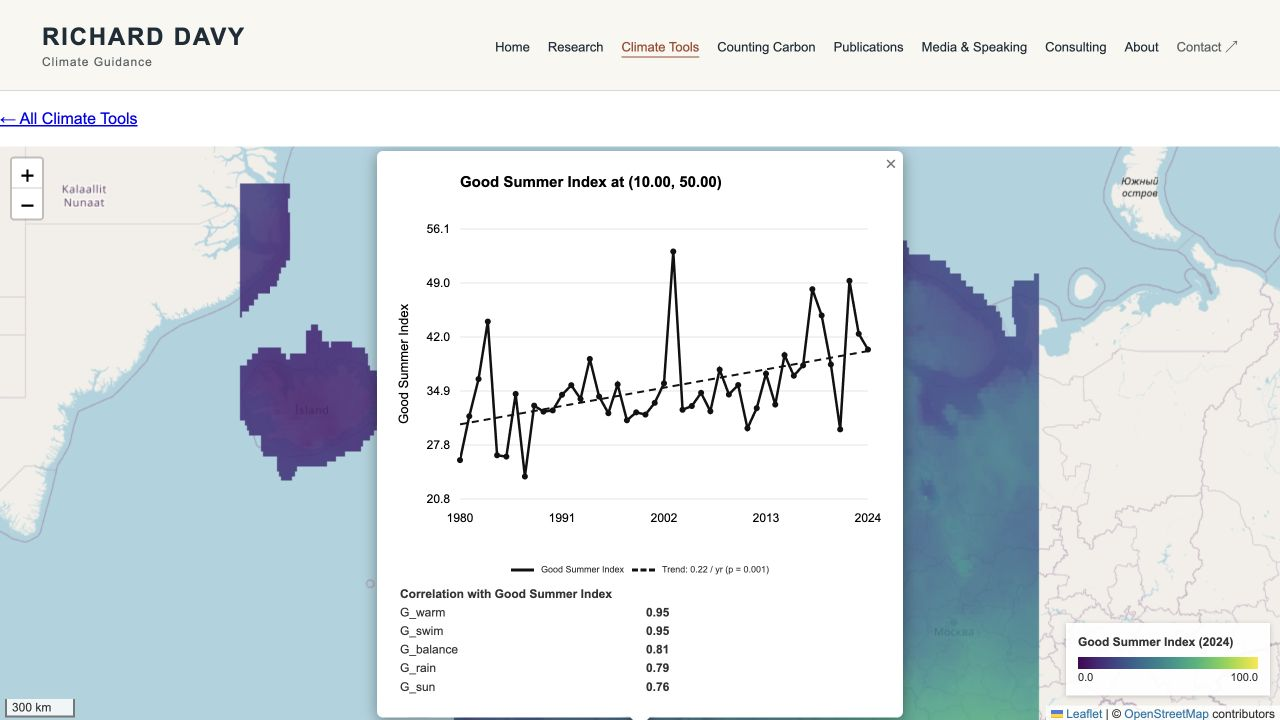
How has the Good Summer Index varied at a chosen location?
Supplied 1980–2024 annual fields, linear trends and component correlations.
An index devised by Richard Davy. The component relationships and trend calculation are explained in the tool.
In conversation
Editorial coverage by Jane Braxton Little drawing on day/night warming research.
View explainer ↗