Navigate Climate Complexity with Confidence

We offer world-class climate consulting and data-driven solutions for businesses, governments, and NGOs.

Explore Our Services

Tailored to Your Decision Timeframes

We customize climate insights for the specific planning horizons of our clients. Whether you need to respond to short-term operational shifts or plan decades ahead, our team delivers data and guidance aligned with your exact needs:

Seasonal Forecasts (3–12 months)

Perfect for short-term decision-making, such as ski centers anticipating snowfall or farms preparing for anomalous warmth and rainfall.

Climate Predictions (2–10 years)

For mid-range planning needs, such as wind-farm siting or building infrastructure that must handle evolving climate patterns over the next decade.

Climate Projections (5–50+ years)

For long-term adaptation—from national park management to rewilding projects—based on the same robust models used by the IPCC, ensuring resilience for decades to come.


Curious about real-world applications? Check our Case Studies for examples of our partnerships, or visit our Data Interaction page to see our tools in action. We also offer training courses on effective usage of these tools.

What We Offer

1) Tailored Climate Data

Bringing climate data and uncertainty into focus for local issues. Many organizations have a qualitative grasp of climate change but lack the quantitative insights needed to prioritize and adapt effectively. We solve this by delivering high-resolution, uncertainty-aware data directly relevant to your local context.
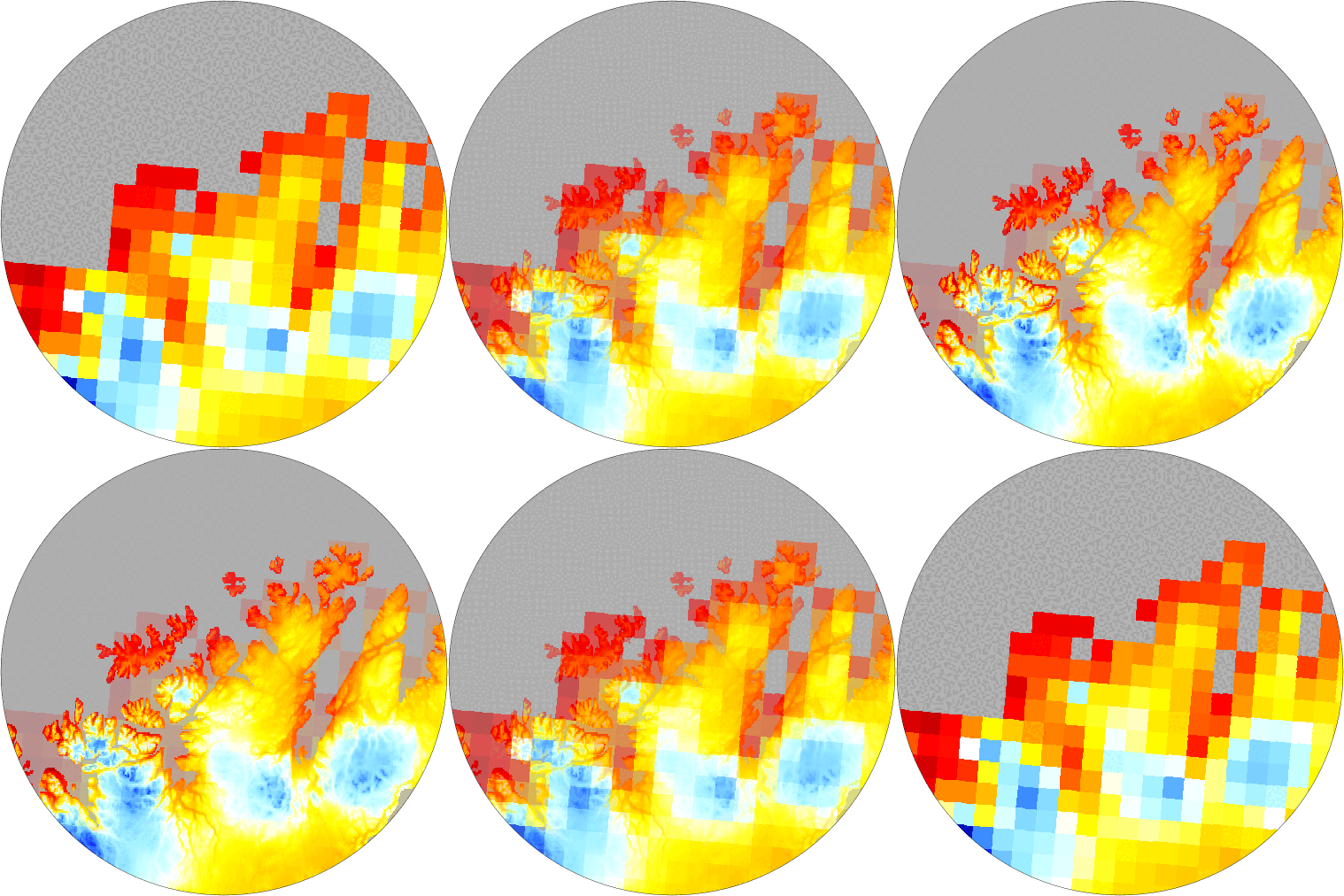
High-Resolution Data Enhancement

Why Our Solution?
We remove biases, improve resolution, and communicate uncertainties—so you can plan for multiple scenarios. Whether exploring short-term variability or longer-term trends, you will be ready for evolving climate realities.

2) Climate Consulting

We provide comprehensive and comprehensible summaries of the latest climate research. If you feel lost in an ocean of scientific literature—where IPCC reports may be too dense or not localized—our tailored consulting offers the clarity you need.

Climate Consulting

Why Our Solution?
We distill cutting-edge climate science into actionable guidance, bridging the gap between global reports and region-specific challenges. Get accessible briefs, clear communication, and data-driven recommendations suited to your local context.

3) Interactive Data Tools

Bring your climate data to life with web-based tools that let you explore scenarios and timelines dynamically. We have an example on our Data Interaction page. As your data needs evolve, these platforms help you visualize, compare, and adapt without commissioning new studies each time.
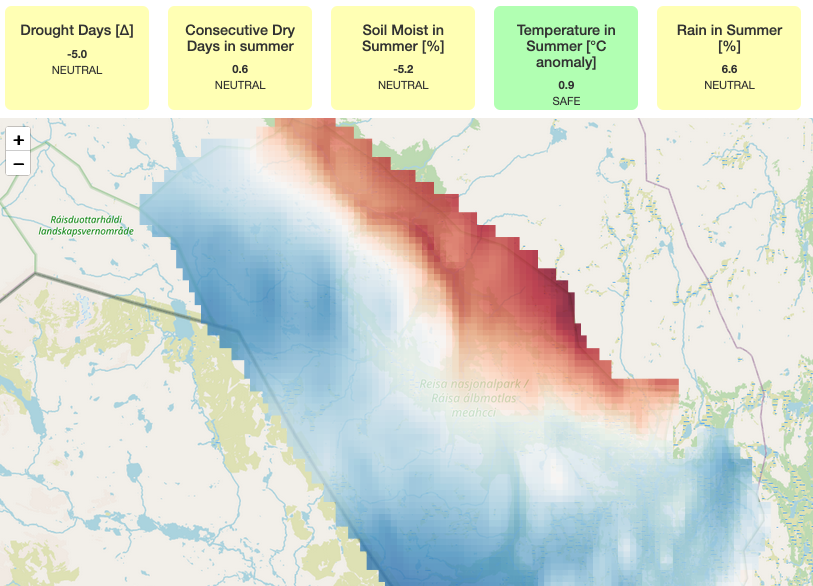
Data Interaction

Why Our Solution?
Static reports quickly become outdated. Our interactive tools provide ongoing flexibility, ensuring you can drill deeper into the data, test what-if scenarios, and keep pace with evolving challenges.

Our Data & Methods

At Climate Compass we ground our projections in community-standard CMIP6 global models and CORDEX regional models. CMIP6 is the latest phase of the Coupled Model Intercomparison Project and provides a scientifically robust foundation for the IPCC Sixth Assessment Report. CORDEX coordinates regional climate downscaling and provides high-resolution regional climate projections, while the EURO-CORDEX branch increases spatial resolution for Europe to about 12 km. 123

To capture local variability and extremes beyond the reach of coarse models, we use convective-permitting simulations and our own statistical downscaling software (KrigR). Convection-permitting models operate on grid spacings smaller than 4 km and explicitly resolve deep convection. Reviews show that they reduce errors in larger-scale models and add value for convective processes, regional extremes, and mountainous regions. Our downscaling workflow then optimizes the spatial detail for the variables and decisions that matter most to the client. 4

Climate data are increasingly accessible, but they are often still hard to find, interpret, and apply correctly in decision-making. The World Meteorological Organization notes that decision-makers often need climate information that is local, credible, and usable, and that many users do not have the expertise to choose the best model or dataset for their purpose. Our role is to bridge that gap by curating the right evidence, explaining strengths and limitations clearly, and delivering outputs in forms that support adaptation and mitigation planning. 5

Frequently Asked Questions

What climate models do you use?

We base our analyses on the latest CMIP6 global models and CORDEX regional ensembles, then refine them with convective-permitting simulations and our own downscaling methods. This gives us both broad scientific consistency and the finer-scale detail needed for local decision-making. 124

Why are CMIP6 and CORDEX considered the standard?

CMIP6 is the current coordinated international framework for global climate models and underpins the IPCC Sixth Assessment Report. CORDEX is the main coordinated framework for regional climate downscaling and was designed specifically to connect climate-model output with impact, adaptation, and mitigation studies. 12

What is convective-permitting modelling, and why does it matter?

Traditional large-scale climate models often rely on parameterizations for thunderstorms and other small-scale processes. Convection-permitting models run at much finer grid spacing, typically below 4 km, so they can represent those processes more directly. This is especially important for intense rainfall, local extremes, and mountainous terrain. 4

Why do I need high-resolution climate data?

Many real decisions depend on local gradients in climate risk and exposure. Coarser models can miss topographic effects, small-scale precipitation differences, and localized extremes. High-resolution layers help translate climate change into something actionable for assets, ecosystems, infrastructure, and planning zones. 45

Why do I need guidance if climate data are publicly available?

Public availability does not automatically make climate data easy to use. Choosing among models, scenarios, variables, time horizons, and downscaling choices still requires expert judgment. WMO highlights that many users struggle to understand and apply climate information, and that usable climate services must be shaped around the actual decision context. 5

What deliverables do you provide?

Depending on the project, we can provide high-resolution spatial layers, tailored indicators, narrative briefs, interactive dashboards, workshops, and custom reports. Across the wider climate-risk field, buyers commonly look for deliverables such as maps, narrative documents, raw data, and dashboards. We tailor the mix to what will be most usable for the client and their stakeholders. 6

How do your workshops and training help clients?

Our workshops help users understand how to access, evaluate, combine, and communicate climate information. The aim is not just to hand over data, but to build confidence in using the right evidence for the right decision. That is especially important because many decision-makers do not have in-house expertise to evaluate model strengths, weaknesses, and uncertainties on their own. 5

Sources

  1. ClimateData.ca, “CMIP6 Frequently Asked Questions”
  2. EURO-CORDEX, “About”
  3. CORDEX, “Coordinated Regional Climate Downscaling Experiment”
  4. Prein et al. (2015), “A review on regional convection-permitting climate modeling”
  5. World Meteorological Organization, “Why Does Access to Good Climate Data Matter?”
  6. ClimateCheck, “11 questions real estate investors must ask climate data providers”